
Applications
Where this spring style fits
Review best-fit uses, assembly constraints and situations where another spring style may be a better choice.
View application guidance →Torsion Springs
A torsion spring with two working arms used to share rotary load across a wider mechanism or provide balanced return around a common pivot.
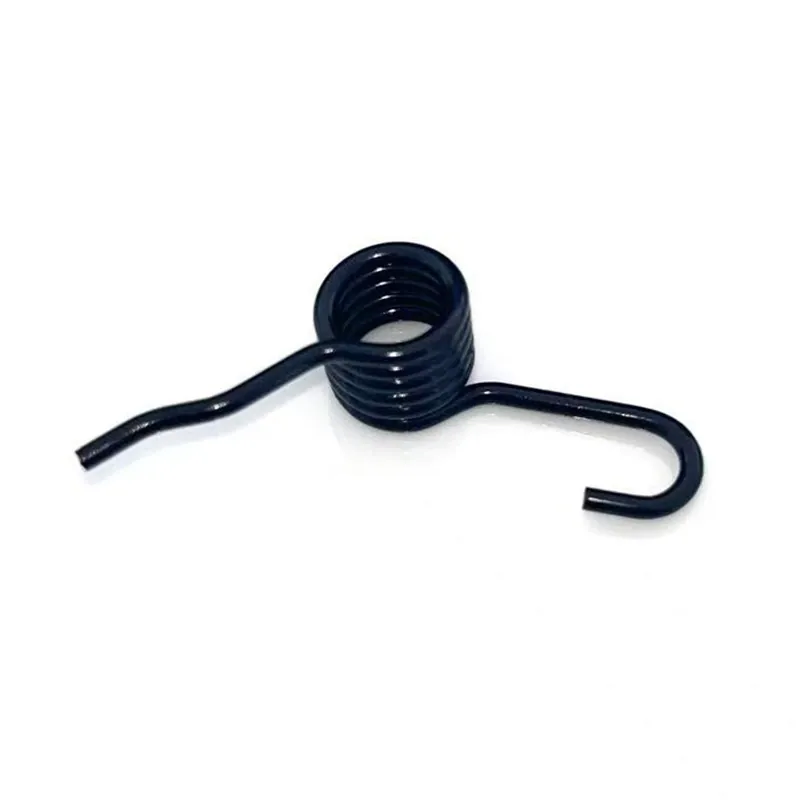
Double-leg torsion springs are selected when two contact points need to move together or when a wider hinge or clamp benefits from force on both sides. Symmetry is important: small differences in leg angle, seating or contact position can make one side engage earlier than the other.
A functional fixture that supports the spring at the same spacing as the assembly gives a more meaningful inspection than measuring each leg independently. First-article checks should include simultaneous engagement.
Product Data
Use these data points to compare practical starting dimensions and material options. Final production specifications are confirmed against your drawing and working conditions.
| Model | Wire dia. | OD | ID | Free length | Rate | Material | Coils | Max load |
|---|---|---|---|---|---|---|---|---|
| ST-030-0050-0010-0621 | 0.3 mm | 4.98 mm | 4.38 mm | 1.01 mm | 0.015 | Phosphor Bronze (QSn4-0.3) | 3.2 | 2.13 |
| ST-060-0089-0060-0666 | 0.6 mm | 8.88 mm | 7.68 mm | 6.02 mm | 0.092 | Music Wire (SWP-A) | 9.6 | 7.68 |
| ST-300-0374-0226-0628 | 3 mm | 37.36 mm | 31.36 mm | 22.62 mm | 17.658 | 60Si2MnA Spring Steel | 7.5 | 1790.5 |
| ST-030-0046-0056-0625 | 0.3 mm | 4.63 mm | 4.03 mm | 5.63 mm | 0.006 | Oil-Tempered Spring Wire (SWO) | 18.5 | 0.86 |
| ST-120-0165-0201-0643 | 1.2 mm | 16.49 mm | 14.09 mm | 20.12 mm | 0.289 | Beryllium Copper (QBe2) | 16.4 | 38.51 |
| ST-080-0046-0135-0638 | 0.8 mm | 4.64 mm | 3.04 mm | 13.46 mm | 0.347 | 301 Stainless Steel | 16.2 | 23.81 |
| ST-120-0104-0072-0613 | 1.2 mm | 10.44 mm | 8.04 mm | 7.21 mm | 2.137 | Music Wire (SWP-A) | 5.9 | 360.48 |
| ST-100-0094-0107-0697 | 1 mm | 9.41 mm | 7.41 mm | 10.68 mm | 0.608 | 301 Stainless Steel | 10.3 | 50.25 |
| ST-080-0113-0123-0601 | 0.8 mm | 11.29 mm | 9.69 mm | 12.31 mm | 0.147 | Carbon Spring Steel Wire (SWC) | 14.9 | 11.59 |
| ST-080-0069-0118-0703 | 0.8 mm | 6.88 mm | 5.28 mm | 11.76 mm | 0.274 | 60Si2MnA Spring Steel | 13.8 | 25.4 |
| ST-030-0031-0059-0608 | 0.3 mm | 3.11 mm | 2.51 mm | 5.87 mm | 0.009 | Carbon Spring Steel Wire (SWC) | 18.1 | 1.16 |
| ST-030-0032-0010-0651 | 0.3 mm | 3.23 mm | 2.63 mm | 0.96 mm | 0.049 | Carbon Spring Steel Wire (SWC) | 3.2 | 7.24 |
| ST-050-0064-0050-0687 | 0.5 mm | 6.4 mm | 5.4 mm | 5.01 mm | 0.06 | 304 Stainless Steel | 9.3 | 4.98 |
| ST-400-0302-0618-0686 | 4 mm | 30.24 mm | 22.24 mm | 61.84 mm | 23.01 | Beryllium Copper (QBe2) | 14.8 | 1145.91 |
| ST-120-0144-0040-0592 | 1.2 mm | 14.41 mm | 12.01 mm | 3.98 mm | 2.845 | 65Mn Spring Steel | 3.1 | 122.6 |
| ST-180-0213-0366-0690 | 1.8 mm | 21.26 mm | 17.66 mm | 36.6 mm | 1.546 | Music Wire (SWP-A) | 19.6 | 84.11 |
| ST-120-0105-0212-0712 | 1.2 mm | 10.48 mm | 8.08 mm | 21.25 mm | 0.743 | 65Mn Spring Steel | 16.9 | 62.69 |
| ST-050-0054-0076-0636 | 0.5 mm | 5.41 mm | 4.41 mm | 7.63 mm | 0.051 | Music Wire (SWP-A) | 14 | 3.47 |
| ST-080-0073-0035-0624 | 0.8 mm | 7.33 mm | 5.73 mm | 3.53 mm | 0.768 | 304 Stainless Steel | 4.3 | 54.74 |
| ST-300-0310-0176-0706 | 3 mm | 30.95 mm | 24.95 mm | 17.65 mm | 28.07 | 65Mn Spring Steel | 5.8 | 3761.36 |
| ST-050-0052-0026-0614 | 0.5 mm | 5.19 mm | 4.19 mm | 2.57 mm | 0.147 | 65Mn Spring Steel | 5.1 | 20.29 |
| ST-050-0060-0105-0591 | 0.5 mm | 6.04 mm | 5.04 mm | 10.52 mm | 0.02 | Beryllium Copper (QBe2) | 19.7 | 2.77 |
| ST-200-0271-0081-0677 | 2 mm | 27.09 mm | 23.09 mm | 8.08 mm | 9.186 | Carbon Spring Steel Wire (SWC) | 3.9 | 802.84 |
| ST-400-0521-0652-0675 | 4 mm | 52.12 mm | 44.12 mm | 65.16 mm | 19.925 | 65Mn Spring Steel | 15 | 3267.62 |
| ST-040-0068-0030-0612 | 0.4 mm | 6.78 mm | 5.98 mm | 2.97 mm | 0.032 | Oil-Tempered Spring Wire (SWO) | 7 | 4.41 |
| ST-600-0263-0238-0671 | 6 mm | 26.27 mm | 14.27 mm | 23.83 mm | 485.383 | Phosphor Bronze (QSn4-0.3) | 3.7 | 45577.42 |
| ST-120-0167-0054-0611 | 1.2 mm | 16.68 mm | 14.28 mm | 5.4 mm | 1.14 | Beryllium Copper (QBe2) | 4.1 | 130.01 |
| ST-040-0046-0020-0603 | 0.4 mm | 4.65 mm | 3.85 mm | 2.04 mm | 0.044 | Beryllium Copper (QBe2) | 4.8 | 4.81 |
| ST-040-0025-0024-0683 | 0.4 mm | 2.48 mm | 1.68 mm | 2.39 mm | 0.126 | Music Wire (SWP-A) | 5.5 | 15.6 |
| ST-080-0051-0082-0642 | 0.8 mm | 5.07 mm | 3.47 mm | 8.16 mm | 0.556 | 65Mn Spring Steel | 9.7 | 57.56 |
| ST-200-0096-0282-0678 | 2 mm | 9.55 mm | 5.55 mm | 28.19 mm | 8.504 | Oil-Tempered Spring Wire (SWO) | 14 | 516.18 |
| ST-300-0204-0582-0641 | 3 mm | 20.41 mm | 14.41 mm | 58.16 mm | 14.361 | Music Wire (SWP-A) | 18.2 | 512.68 |
| ST-030-0043-0052-0663 | 0.3 mm | 4.33 mm | 3.73 mm | 5.17 mm | 0.003 | Phosphor Bronze (QSn4-0.3) | 16.4 | 0.22 |
| ST-300-0423-0225-0629 | 3 mm | 42.29 mm | 36.29 mm | 22.48 mm | 16.545 | Carbon Spring Steel Wire (SWC) | 7 | 857.04 |
| ST-600-0634-0325-0647 | 6 mm | 63.44 mm | 51.44 mm | 32.48 mm | 234.726 | Music Wire (SWP-B) | 5.4 | 15444.98 |
| ST-040-0061-0050-0648 | 0.4 mm | 6.06 mm | 5.26 mm | 5.04 mm | 0.011 | Phosphor Bronze (QSn4-0.3) | 11.5 | 0.89 |
| ST-250-0347-0504-0637 | 2.5 mm | 34.68 mm | 29.68 mm | 50.35 mm | 3.417 | 304 Stainless Steel | 18.7 | 444.49 |
| ST-600-0658-0315-0704 | 6 mm | 65.76 mm | 53.76 mm | 31.48 mm | 228.286 | 304 Stainless Steel | 5 | 27348.65 |
Rate: N-mm/degree; maximum load: N-mm. Dimensions are in millimeters.
Next Design Decisions
Once the spring style is selected, confirm how it works in the assembly, which material suits the environment, how it will be manufactured and which dimensions and performance points should be controlled on the drawing.
Applications
Review best-fit uses, assembly constraints and situations where another spring style may be a better choice.
View application guidance →Materials
High fatigue strength is often important because both legs can cycle repeatedly. Material and heat treatment should be chosen around angular travel and expected life, not only static torque.
Compare spring materials →Manufacturing
Review forming, heat treatment, secondary operations, inspection and the path from first samples to repeat production.
View manufacturing capabilities →Engineering Data
Matching material and wire-diameter pages provide additional design data for material and size selection.
Open Spring Engineering Guide →Material Direction
The links below are selection guides, not a claim that every grade is suitable for every size or load.
Review the design and measurement requirements for this spring family.
Engineering Support
Use these guides to compare material, wire diameter and standard requirements before finalizing the product drawing.
Compare Designs
Use these alternatives when the available space, connection style, travel or force direction changes.
Torsion Springs
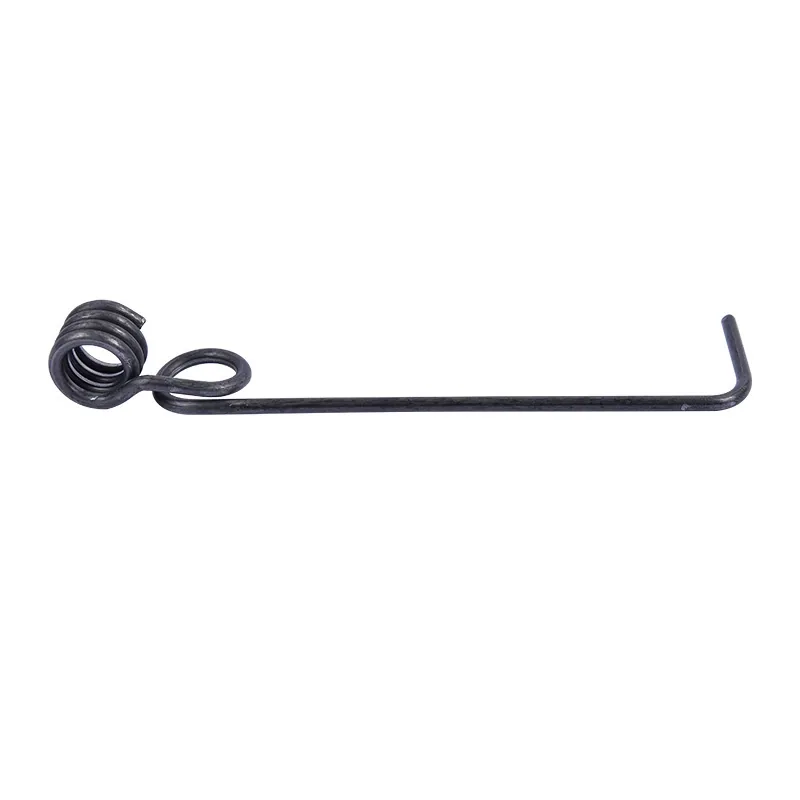
A torsion spring with simple straight arms for hinges, levers and pivots where both contact points can be defined directly from the coil axis.
Torsion Springs
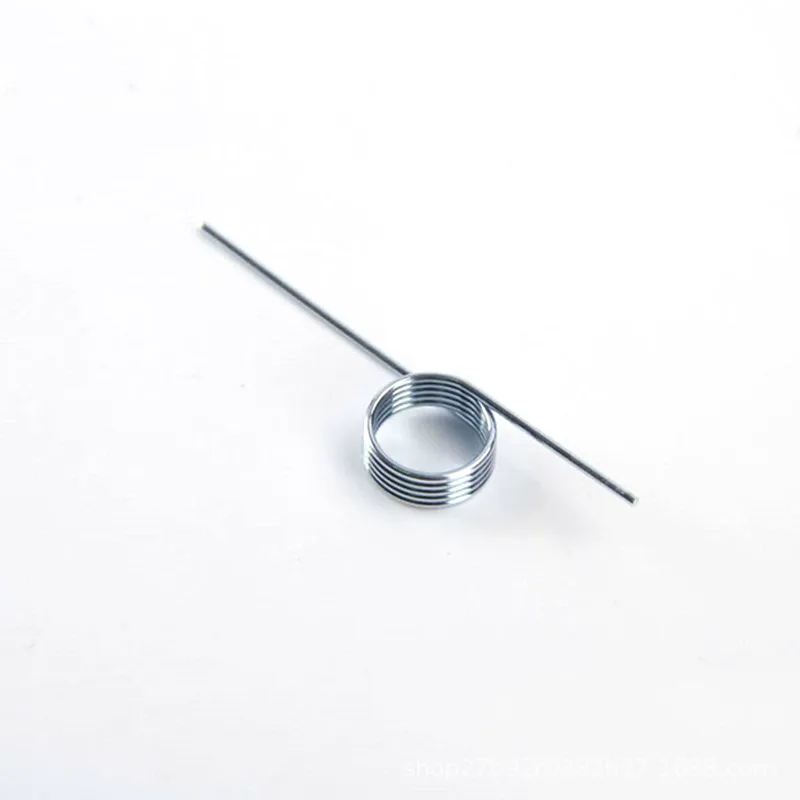
A compact torsion-spring arrangement with one main working arm and the opposite end retained close to the coil for one-sided rotary return.
Torsion Springs
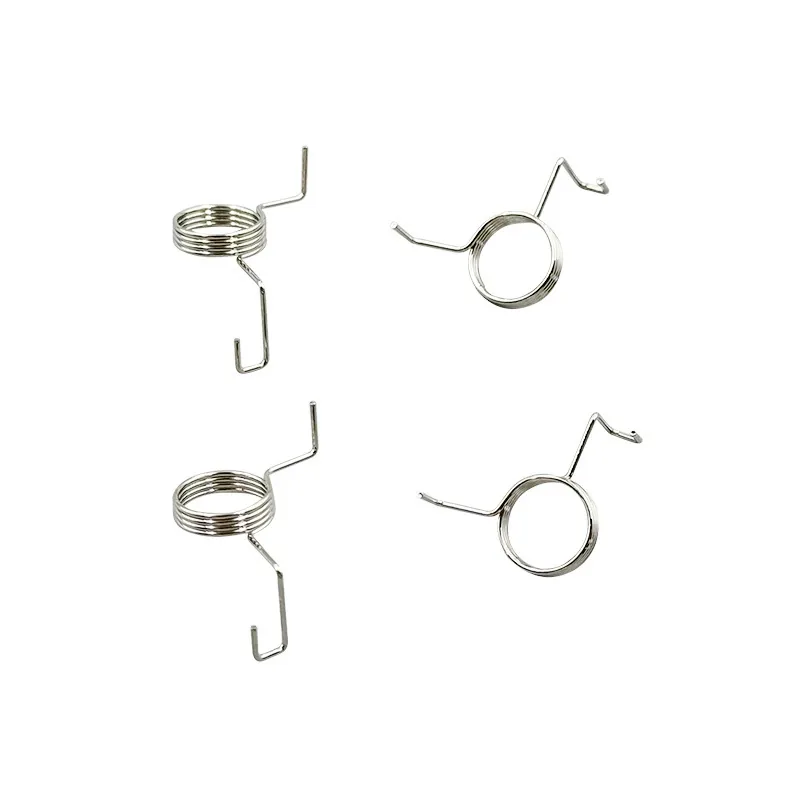
An open U- or hairpin-shaped spring for shallow layouts where two arms flex around a curved center rather than around a tightly wound coil body.
Product Questions
Only if their geometry, seating and contact points are sufficiently symmetrical. Assembly tolerance can cause one side to engage first.
Sometimes. Separate springs can simplify adjustment, while a double-leg spring can reduce part count and maintain a fixed relationship between sides.
RFQ
A drawing is ideal. If you do not have one yet, provide the dimensions, load or torque, travel, environment and expected quantity that matter in the assembly.
CustomSprings Engineering Catalog
Send your dimensions, quantity and drawing for engineering review.