Product Family Overview
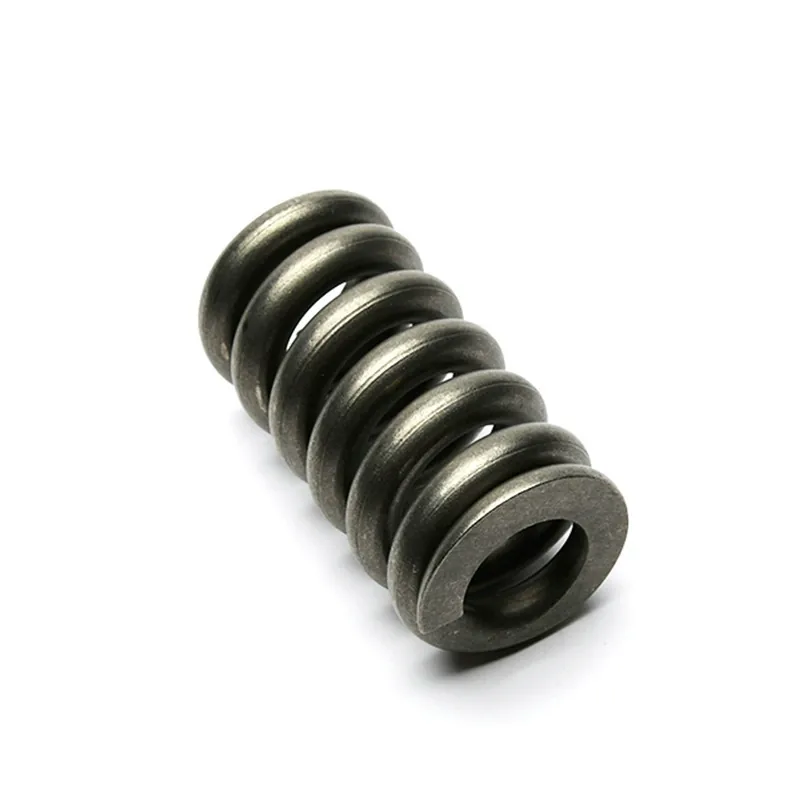
Die Springs for High Load and Repeated Tooling Motion
Die springs are selected around working deflection, load, available bore or rod space and the number of cycles expected in the tool. Duty-class references are useful for screening, but the working stroke should stay within the appropriate operating range instead of using the full theoretical compression as the normal cycle.
Selection
Duty Class, Stroke and Installation Space Work Together
A higher duty class is not automatically better if the tool requires more travel or if the available bore limits the spring size.
ISO 10243 duty-class designs
Standardized duty classes provide a useful starting point for bore size, free length, force and recommended deflection in die and tooling applications.
High-cycle tooling
Cycle rate, heat buildup, guidance, preload and working deflection influence service life in repeated stamping or forming operations.
Valve and engine-type high-load springs
Application-specific high-load coil springs are quoted from the load curve, working travel, material and fatigue requirements rather than a generic catalog.
Custom Manufacturing Data
Die Spring Reference and Made-to-Order Capability
Where dimensional data is available, the catalog gives a practical starting envelope. Other heavy-load designs remain drawing-based because load curve, duty cycle and installation conditions define the final spring.
- Product designs
- 2
- Engineering data rows
- 12
- Wire / thickness range
- Defined by drawing
- Outside diameter range
- Defined by drawing
- Free length range
- Defined by drawing
Custom RFQ
What to Send for a Die Spring Quote
The quote should identify the working stroke and force, not only the free spring dimensions.
- Bore or rod diameter and available free length
- Required force at installed and working positions
- Working deflection or stroke
- Cycle rate and expected life
- Duty class or applicable standard if required
- Material, finish, temperature and quantity
Project Support
Continue With the Detail Your Project Needs
Use the product pages for specific spring geometry, then continue with application, material, manufacturing or engineering information as needed.
Applications
Compare best-fit uses
Review where spring styles work well, assembly constraints and alternative designs.
View spring applications →
Materials
Select the material family
Compare strength, corrosion, temperature, fatigue and conductivity before choosing a grade.
Compare spring materials →
Manufacturing
Plan prototype and production
See how forming, heat treatment, inspection, first articles and repeat production are reviewed.
View manufacturing capabilities →
Engineering Data
Review engineering data
Use material, wire-diameter and standard guides to support spring selection and drawing preparation.
Open Spring Engineering Guide →