
Where it earns its place
Best-Fit Uses
Low-profile controls and return units
Reduces the height occupied by the spring when the assembly is fully pressed or closed.
Tapered or nesting spring pockets
Matches a widening pocket and can let smaller coils move inside larger coils during compression.
Push-back after a linear movement
Useful when a part is pressed inward and needs to return along the same axis after the load is removed.
Maintaining contact between stacked parts
Helps keep two parts touching when normal movement or tolerance would otherwise create a gap.
Why this style works here
What This Spring Style Solves
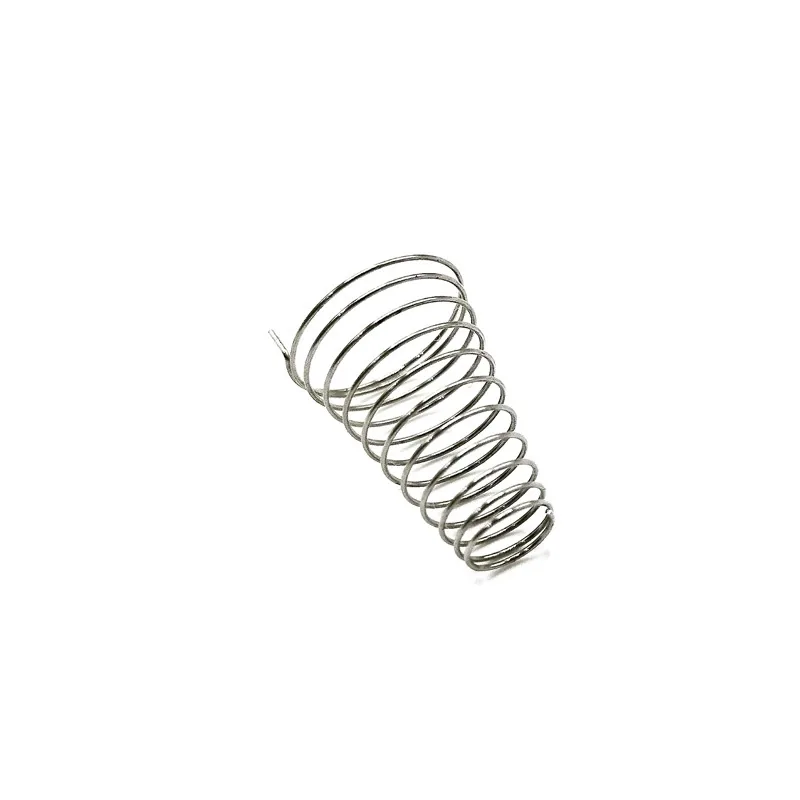
The changing coil diameter is mainly a packaging advantage. With the right wire size, diameters and pitch, neighboring coils can telescope partly or fully as the spring closes.
Before you choose it
What to Confirm in Your Assembly
- Provide both end diameters and the smallest clearances through the full stroke.
- State the maximum allowed compressed height; this is often the deciding requirement for a conical design.
- Give the installed height and the shortest height the spring can reach in service.
- Show any guide pin, bore or nearby wall that controls where the spring can move.
- State the required force at one or more working positions, not only a free length.
Avoid forcing the wrong spring into the design
When Another Spring Style May Fit Better
A tapered appearance does not guarantee near-flat compression. The coil diameters, wire size and pitch must actually allow the coils to nest without interference.
- Cylindrical compression springs when solid height is not critical
- Wave springs for very low axial height
- Disc springs for short travel and high load
Keep material selection separate
Environment & Material Direction
Choose corrosion and temperature resistance after the required load, movement and available space are clear. The Materials section is the right place to compare alloys; this page stays focused on how the spring works in the assembly.
For the material families represented in this product's reference configurations, compare Carbon & Alloy Spring Steels, Stainless Steel Spring Materials, Copper Alloy Spring Materials, Nickel & High-Temperature Spring Alloys. Confirm the exact grade and condition for your assembly.
Move from the use case to the specification
Where to Go Next
Related Spring Design Guides
Review the dimensions, working loads and drawing requirements for this spring family.
Engineering Guides for This Product
These guides contain material, wire-diameter or standard data related to this product.
Application questions
Frequently Asked Questions
Do all conical compression springs compress nearly flat?
No. Near-flat compression depends on the diameter progression, wire size and coil spacing. Some conical springs are tapered mainly for fit or stability and still retain noticeable solid height.
When should I consider a different compression-spring style?
If compressed height is extremely limited, the pocket changes diameter, or the required force must be produced over very short travel, a conical, wave or disc-style spring may package the job more efficiently.
What should I send for an application review?
Send the assembly drawing or a clear sketch, the working positions, the force or torque you need, expected cycles, environment and quantity. If an existing spring is being replaced, include its dimensions and explain what is not working well in the current design.
Same application family