
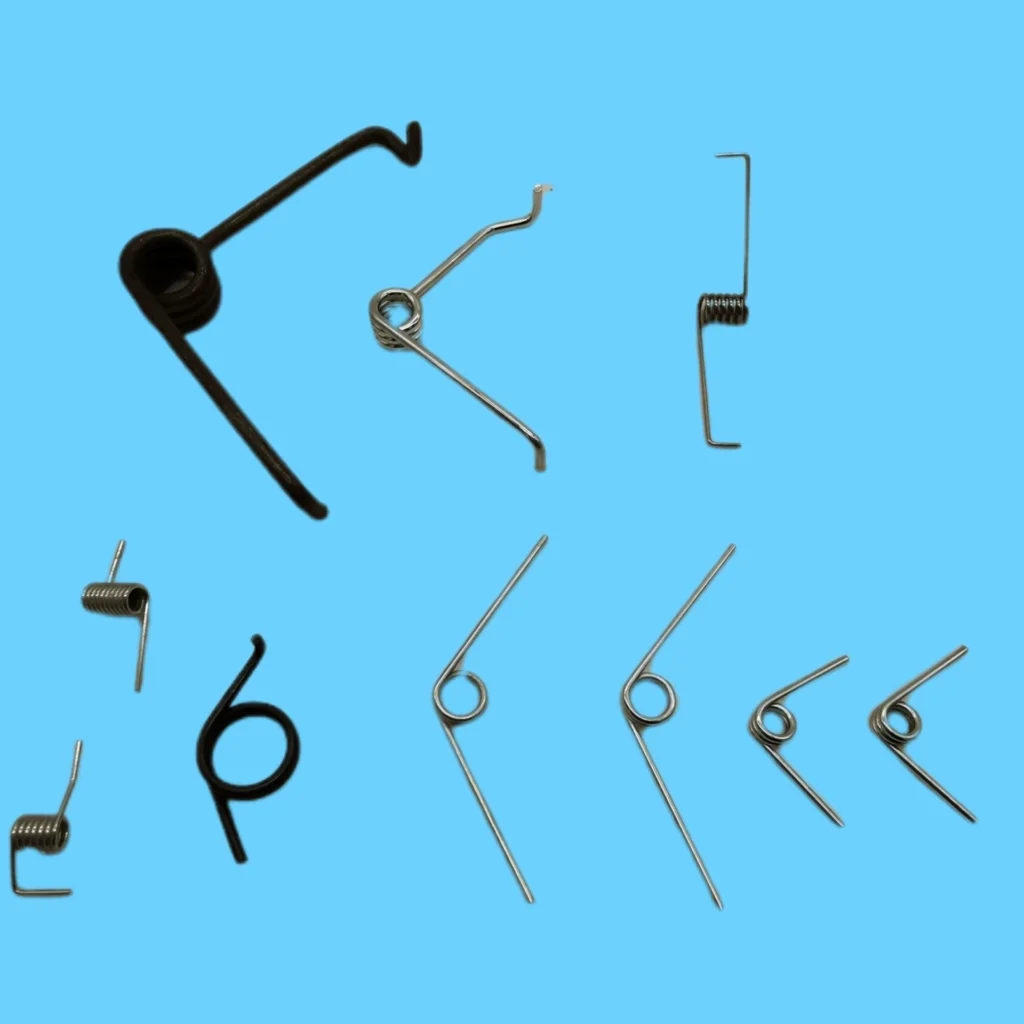
For product selection, compare Torsion Springs.
Key Takeaways
- Torsion spring torque equals spring rate times angular deflection, so you need both a target torque and a specific angle to begin design.
- Wire diameter, mean coil diameter, active coil count, and material modulus determine the spring rate and must be balanced against space and stress limits.
- Leg configuration and mounting shaft support are critical to function and are often the source of field failures if overlooked.
- A complete RFQ includes torque at specific angles, space envelope, leg details, material preference, cycle life, environment, and quantity.
- Exact stress, fatigue life, and dimensions require engineering confirmation; use the Spring Guide and reference data to narrow options before RFQ.
How do you turn a required torque at a specific angle into a torsion spring that fits your assembly, survives the cycle count, and can actually be manufactured? That is the core question engineers and product designers face when specifying a custom torsion spring. The answer starts with the torque–angle relationship, then moves through material selection, leg configuration, stress and fatigue checks, and finally a clean RFQ package.
Answer-First: The Torsion Spring Design Concept
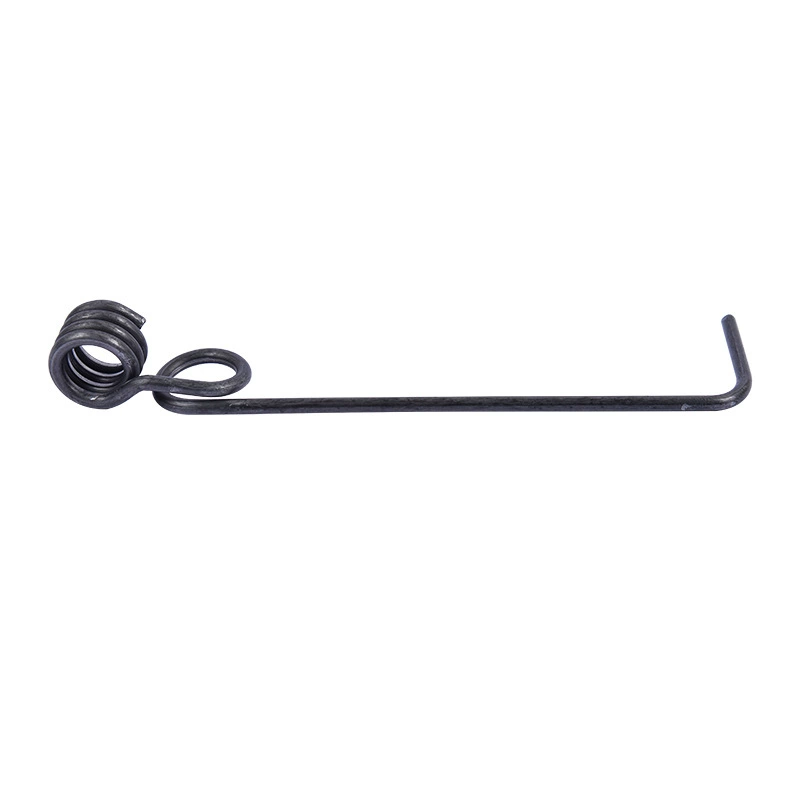
A torsion spring stores energy by twisting, not compressing or extending. It resists rotation around its axis. The spring body is a helical coil, and the ends are formed into legs that transmit torque to your mechanism. When the legs rotate relative to each other, the coil winds tighter or unwinds, creating torque proportional to the angular deflection.
Unlike a compression spring, a torsion spring is usually mounted on a shaft or rod that supports the coil and prevents buckling. The legs bear against two reaction points—often a housing wall and a moving arm. The spring’s job is to return that arm to a known position or to hold a load with a predictable torque.
Designing a torsion spring means balancing four things: the torque you need, the space you have, the material you can use, and the life you expect. Get one wrong and the spring may relax, break, or simply not fit. This guide walks through the relationships and the data you need before you can calculate anything meaningful.
Key Formulas and Engineering Relationships
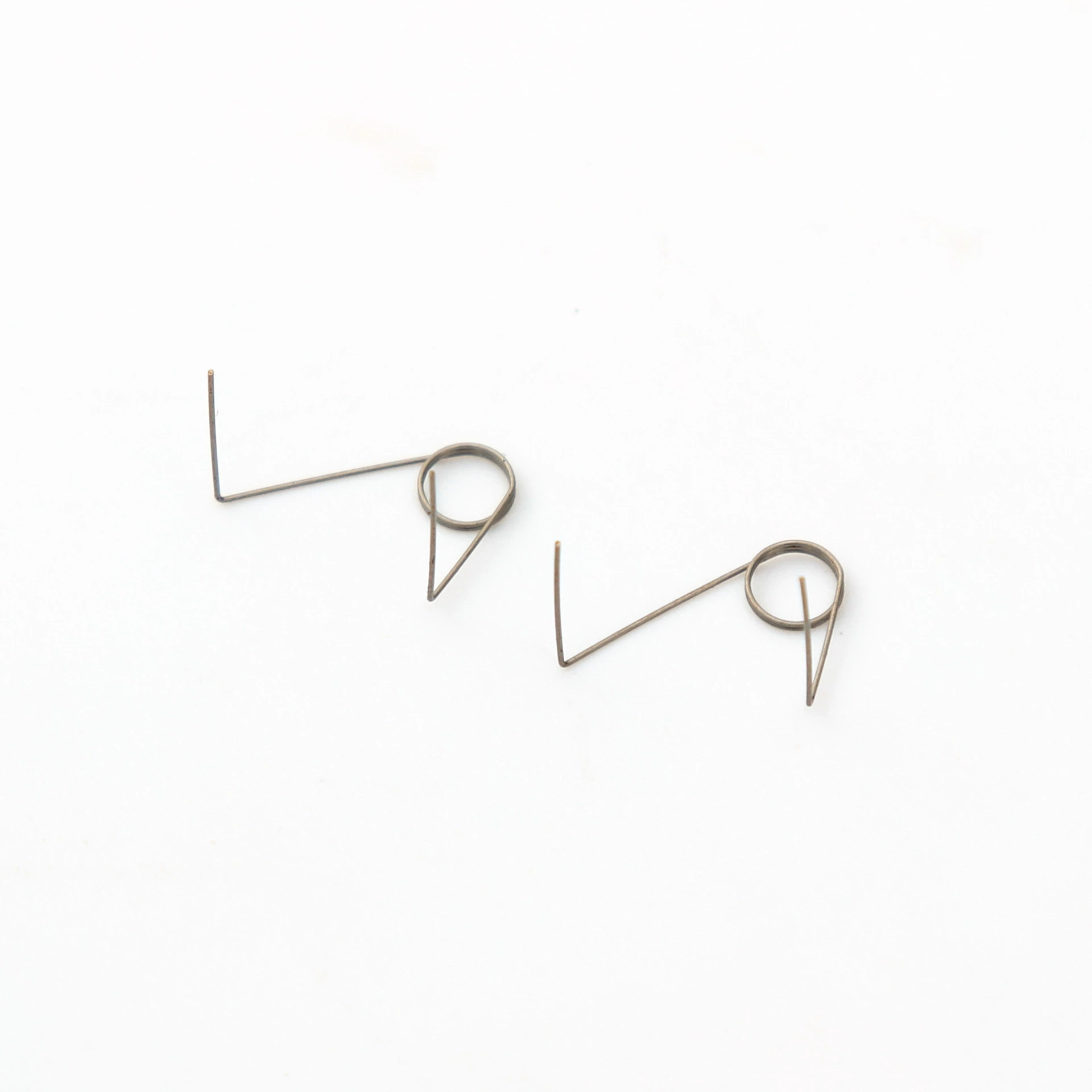
The fundamental relationship for a torsion spring is simple in concept: torque equals spring rate times angular deflection. In equation form, T = k × θ, where T is torque, k is the spring rate (torque per degree or per radian), and θ is the angle of deflection from free position.
The spring rate itself depends on wire diameter, mean coil diameter, active coil count, and the material’s modulus of elasticity. A larger wire diameter increases rate dramatically; a larger coil diameter decreases it. More active coils reduce rate. These are the same levers you would use on a compression spring, but the output is rotational rather than linear.
Stress in the wire is not uniform. The inner surface of the coil sees higher stress than the outer surface because of the curvature of the wire. This curvature effect is why torsion spring stress calculations include a correction factor. Bending stress is the primary concern, and it must stay below the material’s allowable stress for the application.
Deflection angle is measured between the free position and the loaded position. You also need to account for the initial tension or the position of the legs. If the legs are pre-loaded against stops, the spring starts at a non-zero torque. That pre-load must be included in the design.
For a more detailed walkthrough of these relationships and material properties, the site’s Spring Guide and reference data pages are the right place to start. They provide the background you need before plugging numbers into a calculator.
Inputs Engineers Need Before Calculation
You cannot calculate a torsion spring without a complete set of inputs. Here is the checklist we ask for during drawing review.
- Torque requirement: The torque at one or more specific angles. If you only know the force at the end of an arm, convert it to torque using the arm length.
- Angular travel: The total rotation from free position to maximum loaded position. This defines the deflection range.
- Space envelope: Maximum outside diameter, maximum body length, and the shaft diameter the spring will mount on. The spring must fit without binding.
- Leg configuration: Straight legs, bent legs, hooked ends, or special shapes. Leg length, angle, and orientation relative to the coil.
- Wire diameter and material: If you have a preferred wire size or material grade, share it. If not, we can propose options based on stress and fatigue requirements.
- Cycle life: How many cycles the spring must endure. This drives material choice and allowable stress.
- Environment: Temperature range, moisture, chemicals, and whether corrosion resistance is required. This affects material selection and any coating or plating.
- Assembly method: How the legs engage, whether the spring is captured on a shaft, and whether there is any pre-wind during installation.
Missing any of these inputs means the design is a guess. Engineering confirmation is required before committing to a final geometry.
Design Trade-Offs and Warning Signs
Torsion spring design is full of trade-offs. Increasing wire diameter raises torque capacity but also raises stress and may exceed your space. Reducing coil count increases rate but concentrates stress. Choosing a higher-strength material can allow higher stress, but it may reduce ductility and make forming the legs more difficult.
Watch for these warning signs:
- Stress too close to the material limit: If your calculated stress is near the allowable, fatigue life will suffer. A small increase in deflection could cause early failure.
- Leg interference: Legs that rub against the coil or each other during rotation will wear and change torque.
- Insufficient shaft support: A torsion spring without a shaft can buckle or shift, changing the effective leg angle.
- Ignoring pre-load: If the spring is installed with the legs already deflected, the starting torque is not zero. Failing to account for this leads to incorrect torque at the working position.
- Corrosion without protection: In humid or chemical environments, plain carbon steel will rust. Stainless steel or a protective coating may be required.
These issues are easier to catch before tooling than after. A design review with a spring manufacturer can surface them early.
When to Use the Spring Guide, Calculators, or Reference Data
If you are in the early concept stage and need to understand how torsion springs behave, start with the Spring Guide. It explains the fundamentals without requiring exact numbers. If you have a target torque and angle but need to explore wire sizes and coil counts, a spring calculator can help you iterate. Reference data pages provide material properties, allowable stress ranges, and standard sizes that inform your choices.
Do not guess at dimensions or material grades. The cost of a wrong guess is a prototype that fails or a production run that does not meet torque requirements. Use the reference data to narrow options, then confirm with engineering.
For application-specific guidance, the site’s application pages show how torsion springs are used in real mechanisms. They can help you see how other designers solved similar problems.
Preparing Data for a Custom Torsion Spring RFQ
A complete RFQ package speeds up the quoting and design process. Include the following:
- Application description: What the spring does, how it is mounted, and what it interacts with.
- Torque and angle data: Required torque at specific angles, including any pre-load.
- Space constraints: Maximum OD, body length, shaft diameter, and leg envelope.
- Leg details: A sketch or CAD model showing leg shape, length, and orientation.
- Material preference: If you have one, or note that you are open to recommendations.
- Cycle life and environment: Expected cycles, temperature range, and exposure to moisture or chemicals.
- Quantity: Prototype, pilot, and production volumes. This affects tooling and process choices.
- Standards or certifications: Any industry standards the spring must meet.
If you do not have all of these, send what you have. We can help fill the gaps during drawing review. The goal is to avoid assumptions that lead to a spring that does not work.
For torsion springs specifically, the leg design is often the most overlooked part. A straight leg is simplest, but a bent or hooked leg may be needed to engage a feature. The leg bend radius and length affect stress concentrations. Share your leg requirements early so they can be evaluated alongside the coil design.
Consolidated Design Overview
| Aspect | Details | Why It Matters |
|---|---|---|
| Torque and angle | Required torque at specific angles, including pre-load | Defines the spring rate and deflection range |
| Space envelope | Max OD, body length, shaft diameter | Determines feasible wire diameter and coil count |
| Leg configuration | Straight, bent, hooked, or special shapes | Affects stress concentrations and assembly |
| Material and environment | Temperature, moisture, chemicals, cycle life | Drives material selection and allowable stress |
| Stress and fatigue | Bending stress with curvature correction | Ensures the spring survives the required cycles |
| RFQ data | Application, torque, space, legs, material, cycles, quantity | Enables accurate quoting and design review |
If you are ready to move from concept to a manufacturable spring, send your drawing or specification for review. Our engineering team can confirm dimensions, suggest material options, and provide a quote. Visit the RFQ page to start the conversation.
Frequently Asked Questions
What information do I need to design a torsion spring?
You need the required torque at one or more specific angles, the total angular travel, the space envelope including maximum outside diameter and shaft diameter, leg configuration, material preference, cycle life, and environmental conditions. Without these inputs, any calculation is an estimate. Engineering confirmation is required for final dimensions.
How do I calculate torsion spring torque?
Torque equals spring rate times angular deflection. The spring rate depends on wire diameter, mean coil diameter, active coil count, and the material's modulus of elasticity. Because stress varies across the wire section, a curvature correction factor is applied. For exact calculations, provide your project data for engineering review.
What causes torsion springs to fail early?
Common causes include stress that is too close to the material limit, leg interference or wear, insufficient shaft support leading to buckling, ignoring pre-load during installation, and corrosion in humid or chemical environments. Addressing these during design review reduces the risk of field failures.
Can I use a compression spring formula for torsion springs?
No. Torsion springs work in bending, not compression or extension. The stress distribution and rate calculations are different. Using compression spring formulas will give incorrect results. Refer to torsion-specific reference data or consult engineering.
What should I include in a torsion spring RFQ?
Include an application description, torque and angle data, space constraints, leg details with a sketch or CAD model, material preference, cycle life and environment, quantity, and any required standards. If some data is missing, send what you have and note the gaps so engineering can follow up.
Spring Products for This Guide
Open a product to review its geometry and the information needed for a custom quote.
- Double Torsion SpringsTorsion Springs — geometry and quotation requirements
- Double-Leg Torsion SpringsTorsion Springs — geometry and quotation requirements
- External / Parallel Double Torsion SpringsTorsion Springs — geometry and quotation requirements
- Flat-Wire Torsion SpringsTorsion Springs — geometry and quotation requirements
- Hairpin SpringsTorsion Springs — geometry and quotation requirements
- Internal / Concentric Double Torsion SpringsTorsion Springs — geometry and quotation requirements